— GENERATION 8 · WEISZ-FOGEL-SCHON · THE LIFELINE —
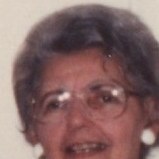
Esther "Etelka" Weisz Schon

Esther "Etelka" Weisz Schon

אסתר
Aunt Esther · the lifeline · 8th of Samuel & Roza's 9 children · Chicago · the writer of the 1980 letter that opens this archive
In Memoriam · natural-death

Esther "Etelka" Weisz — Aunt Esther — was born on 3 October 1905 in Nyírbogát, the eighth of Samuel and Roza Weisz's nine children. She was the family's great communicator: the writer of the 1980 letter from Chicago that opens this archive — the letter in which she sat down at age 75, unprompted, and recorded everything she remembered about her family, her village, and the world she had left behind in 1939.

In August 1939, three weeks before the Nazi invasion of Poland, Esther crossed the Atlantic. She arrived at New York on 7 August 1939 aboard the SS Queen Mary from Cherbourg. Her first husband, Jack (Jenő) Fogel — born 4 August 1909 in Nyíracsad, thirty kilometers east of Nyírbogát — followed her separately. They had married in Nyírbogát on 29 August 1934, but in the chaos of the late 1930s they did not cross together.

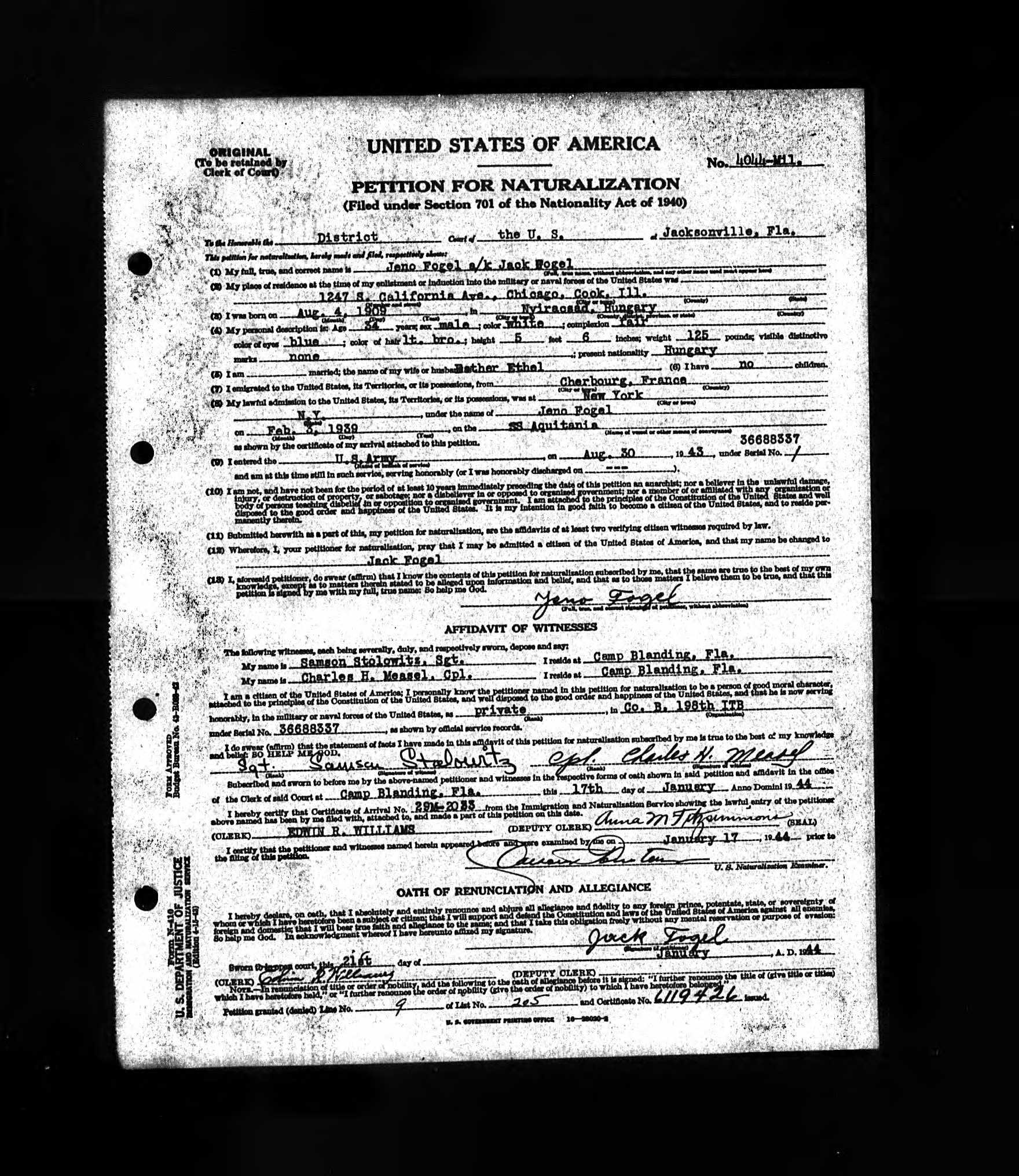
Jack made it to Chicago and found the Hungarian-Jewish community Esther had landed in. They lived together at 1247 South California Avenue — Hymie Feldman's building, the Lawndale apartment that would later, in 1950, be where Bobby first stayed when she arrived in America. Esther filed her petition for naturalization and was naturalized in Chicago on 18 July 1944 (Cert. № 5985976). Less than two months later, on 11 September 1944, Jack — who had enlisted in the U.S. Army on 30 August 1943 and trained at Camp Blanding, Florida — was killed in action at the Battle of Flavigny Bridge in Lorraine, France, during the Allied push toward Germany. He had been a U.S. citizen for less than eight months. The official notification of his death reached Esther in Chicago three days after the actual death.

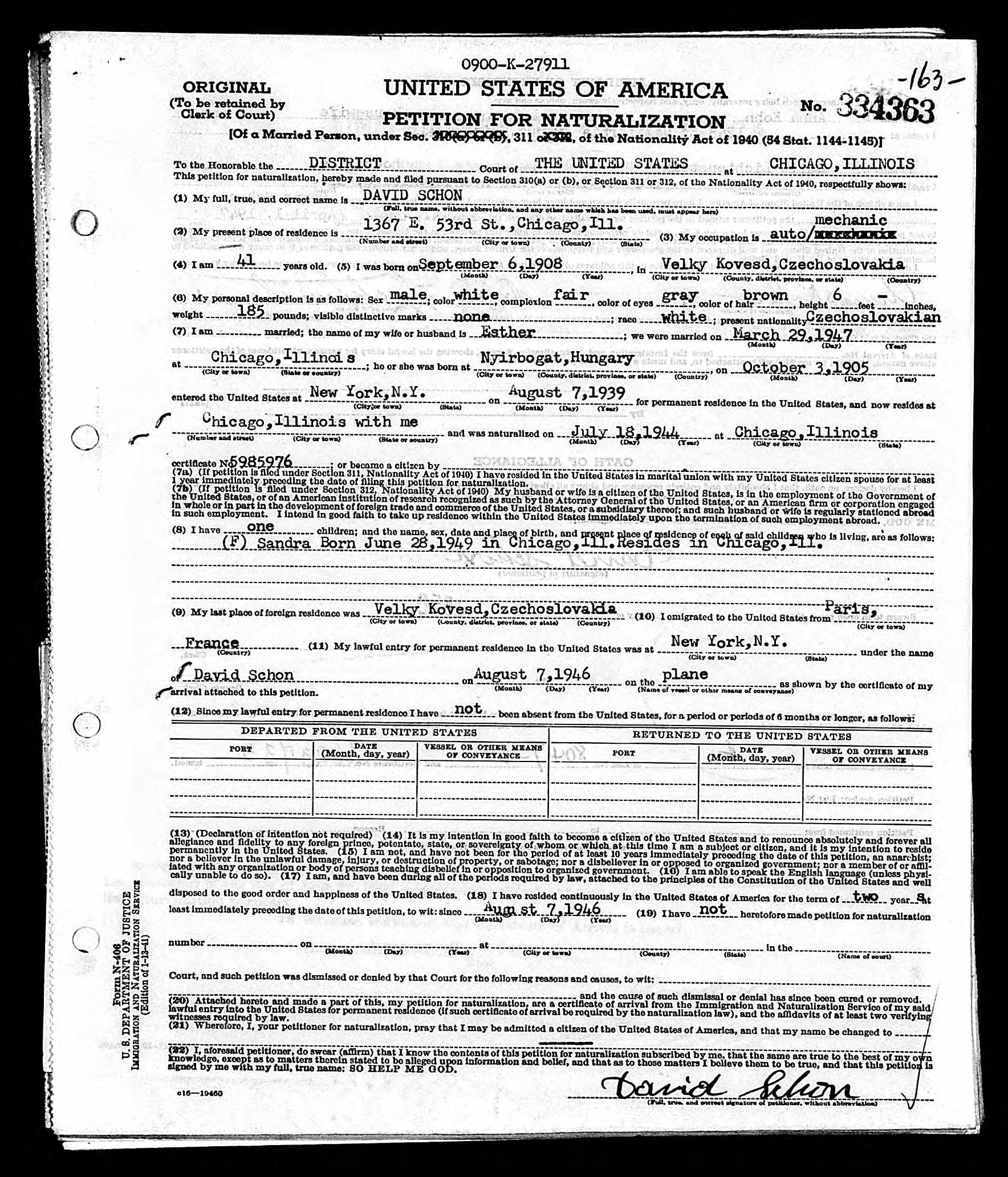
For nearly three years, Esther was a widow. Then, on 7 August 1946 — by airplane, the rare flight rather than a ship, suggesting refugee assistance via HIAS or the JDC — a Holocaust survivor named David Schon arrived at New York. He had been born 6 September 1908 in Velky Kovesd, a Hungarian-speaking Jewish village in eastern Slovakia, just over the Hungarian border. He had survived the camps, made his way through Paris, and reached America. Esther and David married in Chicago on 29 March 1947. David was an auto mechanic. They lived at 1367 East 53rd Street in Hyde Park — a property they rented from Sarah Szerena and Hymie Feldman, who owned it.

On 28 June 1949, their daughter Sandra was born in the 53rd Street house. Sandra was about seven months old when, in February 1950, Esther's niece Bobby finally arrived in America after five years in Sweden. Esther had been preparing for that arrival across the entire decade of the 1940s. Across 1945–1950, Esther sent regular packages from Chicago to Bobby in Sweden — the pre-arrival lifeline. After the war ended and the names of the survivors began to circulate, Esther had located Bobby in the Swedish DP system, and from then forward she had simply not stopped. The packages arrived. They were the work of a sister-in-law, a niece, an aunt — but they were also the work of a woman who had been the next-door villager of every member of the murdered Apagy household. Esther was not a survivor; but she was the connection.

In 1950, when Sandra was one year old, Esther and David purchased a single-family three-bedroom house at 9044 South Merrill Avenue, on the far South Side of Chicago. This was the family home for the next two decades. Sandra lived there until she went away to college in the late 1960s. Bobby (Irene) lived in this house from late 1950 or 1951 until her February 1952 move to Brooklyn for her marriage to Laci. The Merrill Avenue house, in other words, was the place where Bobby finally landed at the end of the long arc that started in Auschwitz, ran through Sweden, and ended in a quiet Hyde Park-adjacent neighborhood with her young cousin Sandra and the aunt who had been writing letters and packing parcels across an ocean for five years.

David died on 1 January 1979, age 70. Esther outlived him by twenty-four years, dying at Skokie, Illinois on 2 July 2003, age 97. By the time of her death, the world she had been born into in 1905 — Hungarian-Jewish Nyírbogát, the kehillah and the chevra kadisha and the Friday nights at her father Samuel's table — had been gone for more than half a century. But she had written it all down in the 1980 letter. It was Esther's letter that, in 2025, would become the founding document of this archive.

Sandra is alive in 2026. She has two married sons — one studying to become a rabbi — and six grandchildren. In 2014 she sat down with Bobby's daughter Rivka and recorded the long interview about Bobby's life that became the source for much of Chapter Six. In 2026 she reconnected with Eli (her second cousin) and has been the source for many of the corrections and confirmations that this archive's recent versions have absorbed. Esther's lifeline did not end when Esther died. It is still open.

F">

Home People Esther "Etelka" Weisz Schon

Aunt Esther was the family’s great communicator. Born in Nyírbogát in 1905, the eighth of Samuel and Roza Weisz’s nine children, she crossed the Atlantic in August 1939 — three weeks before Hitler’s invasion of Poland sealed off the door behind her. She landed at her sister Sarah’s Chicago address, at the Hungarian-Jewish apartment her family had been writing to for sixteen years.

Her first husband, the yeshiva bachur Jack Fogel, was killed in action on a bridge in Lorraine in September 1944. Three years later she remarried David Schon, a Holocaust survivor flown out of Paris. Across the late 1940s, while her brother Lipot was dying in Ebensee and her niece Bobby was rebuilding in Sweden, Esther wrote, packaged, sponsored, and sent everything she could across the ocean — the lifeline that kept Bobby alive until the day Bobby walked into Esther’s Chicago house in February 1950.

In December 1980, at 75, Esther sat down at her kitchen table in Chicago and wrote her daughter Sandra a four-page letter naming everyone she could still remember. That letter is the founding document of this archive. Read her letter →

Ninety-seven years lived. Eighth of nine Weisz children. Thirty-four years in Hungary, sixty-four years in America. Two husbands — the first killed at Flavigny Bridge, the second a survivor flown out of Paris. One daughter, Sandra, living in 2026. Five years of packages to Bobby in Sweden. And four pages, written in December 1980, that became the founding document of this archive.

From civil records, her own 1980 letter, her second husband’s 1949 naturalization petition (which named her), and her niece Bobby’s 2014 testimony.

The civil-record skeleton of Esther’s life. Most of these are referenced or partially transcribed elsewhere in the archive; the originals where held are noted.

The Weisz household in Nyírbogát spoke Magyar. The Yiddish their grandparents had grown up with was, in Esther’s recollection in her letter, “more like German anyway.” By the time Esther was born, the family had been Hungarian for four to five generations. Her Hebrew name was simply Esther; her Hungarian nickname was Etelka. On Sundays the country cousins came in to visit — Bobby, born in 1924, knew her aunt Esther from the time she could remember anything at all.

Three of Samuel and Roza’s children married into the same Feldman family of Jákó. Hanika Weisz — Esther’s oldest sister — married Ignácz Feldman, a cousin. They had three children. Hanika died young. Her widower Ignácz then married another of her sisters, Regina Weisz. And the oldest brother, Lipot Weisz, married Ignácz Feldman’s sister Regina Feldman — making Lipot and Regina also cousins. That third couple were Bobby’s parents.

Cousin marriage was the village pattern — not unusual, and structurally explained by the Grósz sisters of Pétneháza, two of whom (Roza and Miriam) had married into the Weisz and Feldman lines a generation earlier. Esther knew exactly who was related to whom and why; in 1980 she wrote it all out, on lined paper, to make sure Sandra would know too.

In 1934 Esther married Jack — Jenő — Fogel, a young Talmud scholar from Nyíracsad, thirty kilometers east of Nyírbogát. The wedding was in Nyírbogát on 29 August 1934. Bobby was ten years old that summer; she almost certainly was at the wedding.

Five years later, with Hungary already inside the Hitler-Horthy orbit, Esther and Jack made the crossing — but separately. Jack went first, sailing from Cherbourg on the SS Aquitania and entering New York on 2 February 1939. Esther followed six months later, sailing from Cherbourg on the SS Queen Mary and arriving at the Port of New York on 7 August 1939. The destination address she gave on her landing card was the one her older sister Sarah had been writing from for sixteen years: 1247 South California Avenue, Chicago — Hymie Feldman’s apartment in the Hungarian-Jewish neighborhood of Lawndale.

The Chicago lifeline was already in place when Esther arrived. Her sister Sarah Szerena Weisz Feldman had reached Chicago around 1923 and was the family’s pre-war American address. Two Feldman brothers — Henry “Hymie” Feldman and Sam Feldman, both born in Jákó — had migrated through Mobile, Alabama to Chicago years before. Hymie’s apartment was the family flat. By the time Esther landed in 1939, the Chicago Hungarian-Jewish family had been in place for thirty-four years. She did not arrive at a stranger’s flat. She arrived at a community.

Jack enlisted in the United States Army on 30 August 1943, serial number 36688337. He was stationed at Camp Blanding, Florida, and was naturalized in service on 21 January 1944. His petition listed his wife as “Esther Ethel” — the clerk’s transliteration of Etelka — at 1247 S. California Avenue. Less than eight months later, on 11 September 1944, he was killed in action at the Battle of Flavigny Bridge in Lorraine, France, during the Allied push toward Germany. The family in Chicago was notified three days later, on the 14th; they would always remember that date. The actual death was the 11th. He never came home.

After liberation in April 1945, Bobby was evacuated to Sweden as part of Count Bernadotte’s White Buses transport. Esther found her there. How she found her — via HIAS, the Red Cross, the World Jewish Congress, family contacts — we don’t yet know with certainty. But from 1945 forward, Esther sent regular packages from Chicago to Bobby in Sweden. For five years — from when Bobby was twenty-one and refugee, to when Bobby was twenty-five and a green-card immigrant — Esther was the lifeline. Sponsored the visa. Sent the food and the clothes. Kept writing. The packages are confirmed by Bobby’s own 2014 testimony.

In 1947, two and a half years after Jack’s death, Esther remarried. Her second husband was David Schon, born 6 September 1908 in Velky Kovesd, Czechoslovakia — a Hungarian-speaking Jewish village just across the eastern Slovak border. David had survived the camps. Unlike Esther he had survived in Europe, getting out only after the war ended. He arrived at New York from Paris by airplane on 7 August 1946 — the flight is the document’s quietest detail. Most postwar refugees came by ship; a 1946 plane from Paris suggests a survivor with help — HIAS, the JDC, family in Chicago, or all three.

Esther and David married on 29 March 1947 in Chicago. Their daughter Sandra was born 28 June 1949, in their rented Hyde Park house at 1367 East 53rd Street. By the time Bobby arrived in February 1950, Sandra was about seven months old.

David died on 1 January 1979, age 70. Esther outlived him by twenty-four years. In December 1980, at age 75, alone in Chicago, she sat down with lined paper and a pen and wrote her daughter Sandra a four-page letter naming the people of her family. She wrote it, she said in the opening line, “for you to know your roots, of which you can be very very proud, as I am.” She wrote it because she was afraid the part of the family that had not reached America would otherwise be forgotten.

Every claim on this page traces back to one of the sources below. Anything that isn’t in these sources is left as an open question in the gaps block at the bottom — not invented.

Four pages, handwritten, December 1980. Esther at age 75, writing to her daughter Sandra. The single most important source for almost everything she said about Nyírbogát, her parents, the village, her siblings, the cousin marriages, and the move to America. It is also the source for the deepest parts of Chapter One (the Polish memory and the 1787 Cohn-to-Weiss surname change) and most of Chapter Five-and-a-Half (the cousin marriages). Original held by Sandra Schon Kiferbaum. Read the letter →

Esther’s daughter, alive in 2026. Source for the 53rd Street and Merrill Avenue residences, the 1947 marriage, David’s death, and many corrections to dates and addresses that the surviving documents could not resolve.

Bobby’s recorded testimony, taken by her daughter Rivka in 2014. Source for the 1945–1950 packages from Esther in Chicago to Bobby in Sweden, and Bobby’s 1950–1952 residence in the Merrill Avenue house.

The keystone document. David’s petition resolved a half-dozen residual gaps: Esther’s exact birthdate, her arrival date, her own naturalization details (18 July 1944, Cert. № 5985976), the 53rd Street address, David’s birthplace and occupation, and Sandra’s birth.

Confirms Jack’s enlistment date (30 Aug 1943), serial number (36688337), his Camp Blanding naturalization (21 Jan 1944, Cert. № 6119426), his marriage to Esther, and his KIA date at Flavigny Bridge on 11 September 1944.

Confirms Esther’s Cherbourg-to-NYC crossing on the Queen Mary, her destination address (1247 S. California Avenue, Chicago), and her status as a married woman traveling alone.

The Esther chapter in the home-page story. Several details on this profile (the Camp Blanding naturalization, the Cherbourg crossings, the Mobile-Alabama Feldman migration route) trace back to that chapter rather than to separate primary sources. Read the chapter →
Read the full letter
The Route · 1648 — 1952
~ Atlantic Ocean ~ 52° N 48° N POLISH-LITHUANIAN COMMONWEALTH HABSBURG TERRITORIES ~ before 1648, the family is here ~ Moravia · Bohemia · Galicia · Austria HUNGARY Poland ~ 1648 German-speaking lands ~ 1660–1787 · the surname changes The Nyírség PETNEHÁZA · APAGY · TISZADOB 1820–1944 · six generations — 1944 — the rupture Brooklyn 21 Aug 1952 · the wedding Chicago Esther · Sarah · Henry N S W E
STYLIZED · NOT TO SCALE ~ Two priesthoods · seven generations · one ocean ~ v4.0 · TRACED FROM THE LETTER
~ 1648 — POLAND

The forefathers leave

Bobby's aunt: "my Father's forfathers came 350 years ago from Poland. I don't have to tell you why?" The why is Chmielnicki and the Deluge — the end of the largest Jewish world that had ever existed. Tens of thousands killed. Hundreds of kehillos destroyed. The survivors move south into the German-speaking Habsburg lands. The family is among them.

IN MEMORIAM
OLDEST BROTHER
Leopold “Lipot” Weisz
Aryeh Refael HaKohen · Bobby’s father · married Regina Feldman
1892 NYÍRBOGÁT — 1945 EBENSEE
IN MEMORIAM
OLDEST SISTER
Hanika Weisz
Hane Tobe · raised Esther · married Ignácz Feldman
1894 NYÍRBOGÁT — 1919 (~25)
IN MEMORIAM
SISTER
Regina Weisz
Married same Ignácz Feldman after Hanika died
1899 NYÍRBOGÁT — 1929 (29)
S
IN MEMORIAM
SISTER · CHICAGO HEAD START
Sarah Szerena Weisz Feldman
Reached Chicago ~1923 · the address Esther landed at in 1939
1902 NYÍRBOGÁT — 1979 CHICAGO
M
IN MEMORIAM
SISTER
Malvina Weisz
Mishked
1897 — 1935 (38)
I
YOUNGER BROTHER
Ignácz “Izeek” Weisz
Iseek · the youngest brother
1909 NYÍRBOGÁT — FATE PENDING
Her husbands Jack the yeshiva bachur, killed at Flavigny Bridge · David the Holocaust survivor, flown out of Paris
J
KIA · LORRAINE 1944
FIRST HUSBAND
Jack “Jenő” Fogel
U.S. Army · KIA Flavigny Bridge, France
1909 NYÍRACSAD — 1944 LORRAINE
SURVIVOR
SECOND HUSBAND
David Schon
Holocaust survivor · flown out of Paris 1946 · auto mechanic
1908 VELKY KOVESD — 1979 CHICAGO
Her daughter Sandra, born 1949 · the living reader of her mother’s letter
S
LIVING
DAUGHTER
Sandra Schon Kiferbaum
Two sons · six grandchildren · reconnected with Eli 2026
B. 28 JUNE 1949 CHICAGO
The Chicago lifeline Pre-war Feldman/Weisz arrivals who laid down the family’s American address before Esther crossed
H
CHICAGO
“HYMIE”
Henry Hyman Feldman
Jákó → Mobile, Alabama → Chicago · the Lawndale apartment at 1247 S. California
JÁKÓ — CHICAGO
S
CHICAGO
BROTHER
Sam Feldman
Jákó → Fiume → Mobile, Alabama → Chicago → Skokie
JÁKÓ — SKOKIE
— THE LONGER STORY —

What we know

Aunt Esther was the family’s great communicator — the writer of the 1980 letter that opens this archive. She was born 3 October 1905 in Nyírbogát, the eighth of Samuel and Roza Weisz’s nine children. By the time her mother had her, her mother was no longer well; Esther was raised in large part by her oldest sister Hanika, whom she would call, sixty years later in Chicago, “the sister I loved the most of all my sisters.”

— THE FACTS WE’VE GATHERED —

The shape of their life

From civil records, family memory, and primary sources. Empty rows are research targets.

Identity
Civil name (born)
Esther Weisz
Hungarian / nickname
Etelka
American family name
Aunt Esther
Civil name (1st marriage)
Esther Fogel
Civil name (2nd marriage)
Esther Schon
Hebrew name
אסתר
Born (civil)
3 October 1905
Place of birth
Nyírbogát, Hungary
Died (civil)
2 July 2003
Age at death
97 years old
Place of death
Skokie, IL
Father
Samuel Weisz · Aryeh Refael HaKohen
Mother
Roza "Sara Rochel" Grósz
Birth-order
Eighth of Samuel & Roza's nine children
1st marriage
29 August 1934 · Nyírbogát · to Jack (Jenő) Fogel
1st husband
Jack (Jenő) Fogel · b. Nyíracsad 1909 · KIA Flavigny Bridge 11 Sept 1944
Arrived NYC
7 August 1939 · SS Queen Mary from Cherbourg
Naturalized
18 July 1944 · Chicago · Cert. № 5985976
2nd marriage
29 March 1947 · Chicago · to David Schon
2nd husband
David Schon · 1908–1979 · auto mechanic
Daughter
Sandra (b. 28 June 1949)
Hyde Park residence
53rd Street · 1947–1950 · rented from Sarah & Hymie
South Side residence
9044 South Merrill Avenue · 1950–late 1960s
Late life
Skokie, IL
Yahrzeit
— not yet documented — +
Spouse
David Schon (1908–1979)
Children
1 · Sandra Schon Kiferbaum
— RECORDS & DOCUMENTS —

The paper trail

Each card below is part of the documented record. Empty slots are open requests.

— THE PEOPLE IN THEIR LIFE —

Family

The generations they stood between.

Their generation THE 5 CHILDREN
Lipot Weisz
IN MEMORIAM
SIBLING
Lipot Weisz
1892 – 1945
SW
SIBLING
Sarah Szerena
— Chicago —
ES
THIS PAGE
HERSELF
Esther "Etelka" Weisz Schon
Aunt Esther · the lifeline · 8th of Samuel & Roza's 9 children · Chicago · the writer of the 1980 letter that opens this archive
IW
SIBLING
Ignácz "Izeek" Weisz
b. 1909
·
IN MEMORIAM
SIBLING
5 other siblings · died young or pre-war
— Nyírbogát —
— PHOTOGRAPHS —

Photographs

Esther with Bobby and Imre
Esther with Bobby and Imre. Chicago 1984 · Schon-Kiferbaum wedding
Chicago family group, 1984
Chicago family group, 1984. Schon-Kiferbaum wedding · with Esther at center
F · family record Simon Grósz · the first to leave In 1909 — five years before the First World War — Simon Grósz filed h
F · family record Simon Grósz · the first to leave In 1909 — five years before the First World War — Simon Grósz filed h. He was the first of the family to make the crossing. Sam Feldman would follow in 1916; Henry Feldman in 1922; Sarah Weisz, Jack Fogel, and finally Aunt Esther came after him. The chain that would, decades later, save Bobby's life, began with this single page.
F · family record The SS Stockholm manifest · 1950 Bobby's passage to America
F · family record The SS Stockholm manifest · 1950 Bobby's passage to America. The 1950 Stockholm manifest records her arrival in New York, where Aunt Esther's chain — the people who had crossed decades earlier — was waiting to receive her. She would settle in Brooklyn, marry Laci Klein (Zeidy), and raise the family that became the Feigs.
F · family photograph Frumie's engagement · Philadelphia An engagement in the next generation — the family's continuing
F · family photograph Frumie's engagement · Philadelphia An engagement in the next generation — the family's continuing.
— PROVENANCE —

Where this comes from

The records, memories, and sources behind each claim.

The Klein × Weisz Archive is a multi-generational record of two Hungarian Jewish lines, joined by Bobby and Laci’s marriage in 1952.

MIGRATED V5.07 · Have something to add?