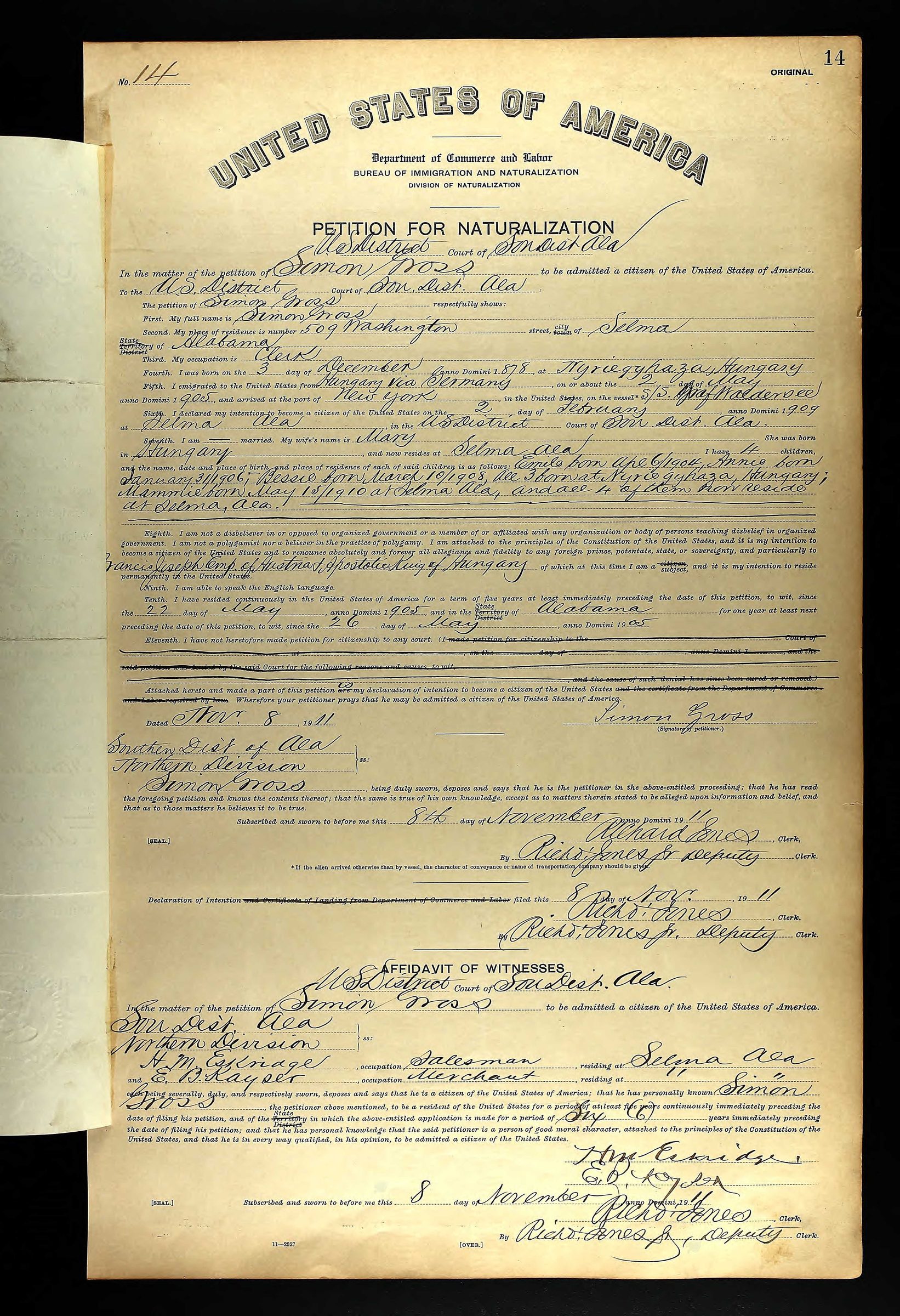
Simon Grósz was the only son of Ferencz Grósz and Háni Berger to leave Hungary. He boarded the S.S. Graf Waldersee at Hamburg in May 1905 and arrived at the Port of New York on the 22nd of that month, age twenty-six. He was single by the count of any American clerk, but in fact he was already a married father — his wife Mary and their first son Emile (just over a year old) had remained behind in Nyíregyháza.
He went to Selma, Alabama, a cotton and commerce town on the Alabama River about fifty miles west of Montgomery. The witnesses on his eventual naturalization papers — H.M. Eskridge, a salesman, and E.B. Kayser, a merchant — suggest he landed in an established small-town merchant network that included at least one other Jewish trader (Kayser). By 1909 he had a clerk's job and an address: 509 Washington Street, Selma.
Mary did not come right away. The naturalization papers contain a small, eloquent piece of evidence about how families were divided in those years: the four Gross children's birthdates. Emile was born in Nyíregyháza in April 1904 — before Simon left. Annie was born there in January 1906, eight months after Simon's emigration. Bessie followed in March 1908, also in Nyíregyháza — meaning Simon either visited Hungary, or Mary made the long journey twice. Only the youngest, Mammie, was born in Selma, in May 1910. By then the whole family had finally crossed.
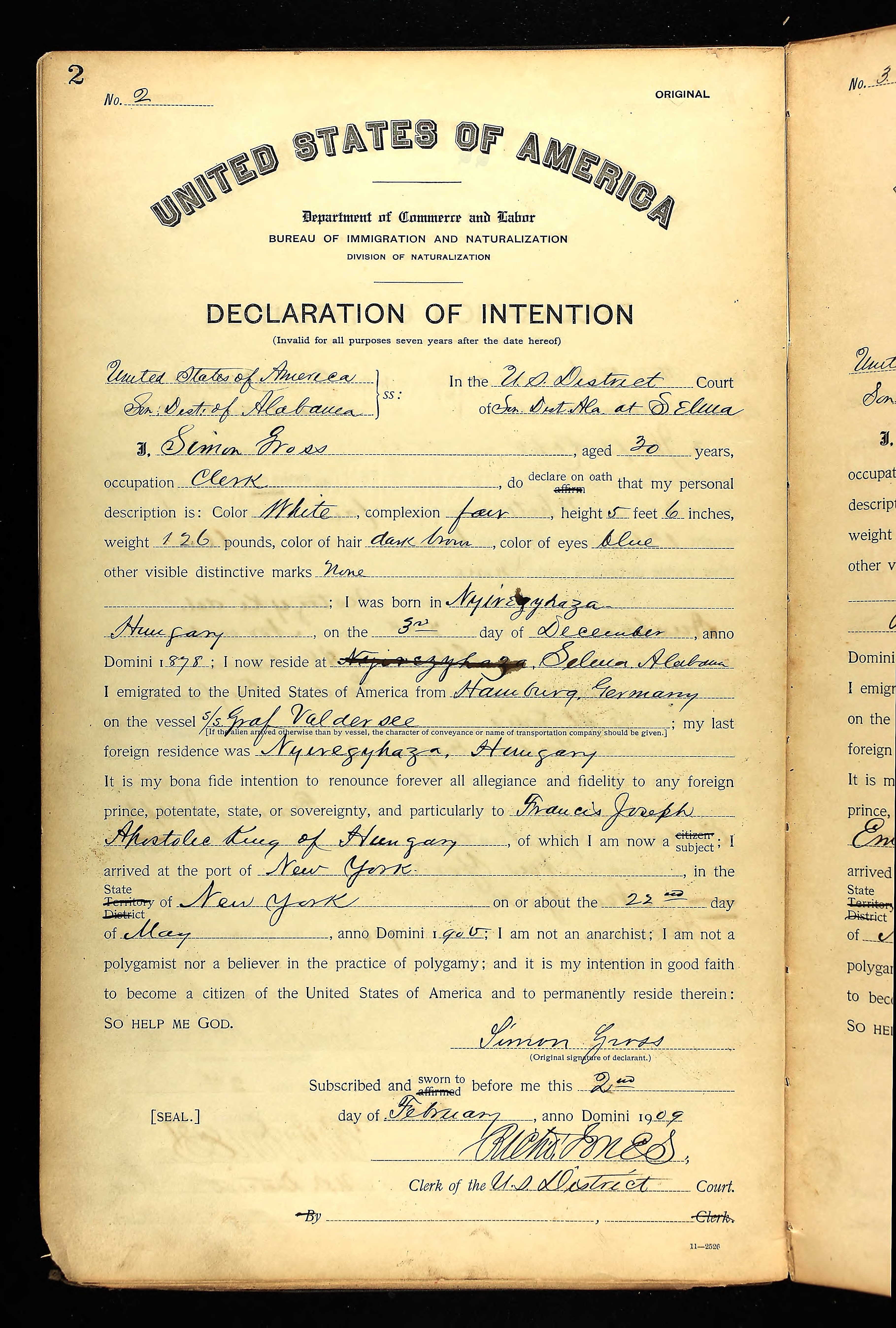
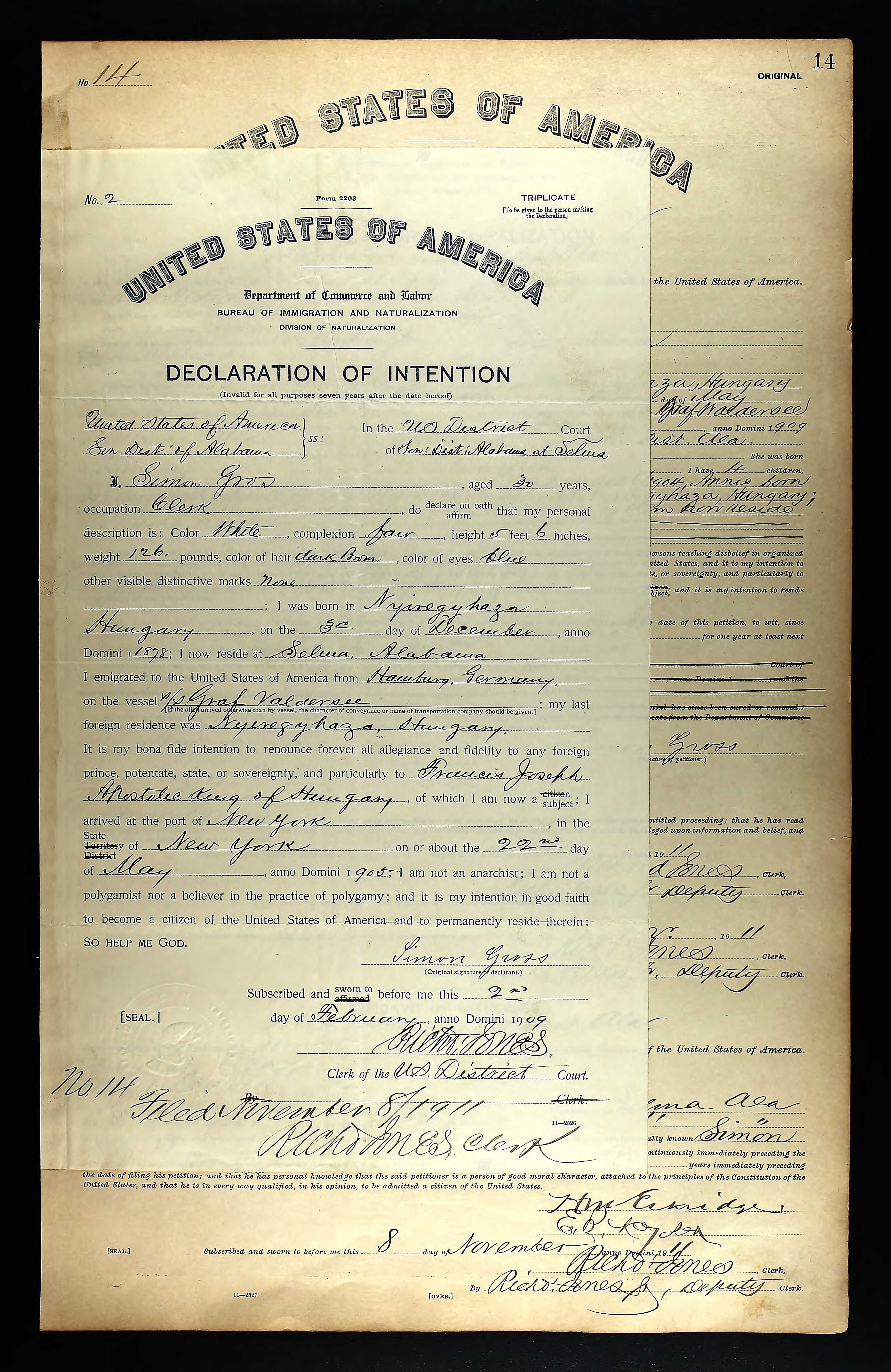
He filed his Declaration of Intention on 2 February 1909 in Selma at the US District Court for the Southern District of Alabama, formally renouncing allegiance to Francis Joseph, Apostolic King of Hungary — Emperor Franz Josef I, who would remain on the throne until his death in 1916. Within ten years that empire would no longer exist. His Petition for Naturalization followed almost three years later, on 8 November 1911.
Simon is the real reason the next-generation nieces (Esther, Szerena) were drawn to America at all. Henry Feldman's 1920s arrival came later. The address that mattered most for the first decade of this family's American history wasn't a Chicago apartment yet — it was 509 Washington Street, Selma, and it had only one name on it.
In 1952, at about seventy-four, Simon traveled from Alabama to Brooklyn for the wedding of his great-niece Bobby Weisz to Laci Klein. Forty-seven years after he had stepped off the Graf Waldersee in New York harbor, the very first member of this family in America stood in a Brooklyn hall watching the founding of the family that would carry the whole story forward. He died in 1957.
Simon Grósz was born on 3 December 1878 in Nyíregyháza, the county seat of Szabolcs in northeastern Hungary — the largest town for an hour’s ride in any direction from the Grósz and Feldman villages of Jákó. He was the only son of Ferencz Grósz and Háni Berger to leave Hungary. He apprenticed in the dry goods trade as a youth and then worked for a number of years in a military commissary in Hungary. By the time he was twenty-six, he was married to Mary Schwarz and they had a one-year-old son, Emile, born in Nyíregyháza in April 1904.
In May 1905 Simon boarded the S.S. Graf Waldersee at Hamburg. He landed at the Port of New York on the 22nd of May 1905. The clerk recorded him as single, age 26. He had answered the question that way himself. He went south — to Selma, Alabama, a cotton and commerce town on the Alabama River about fifty miles west of Montgomery.
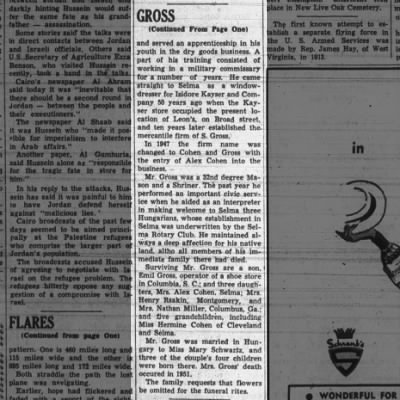
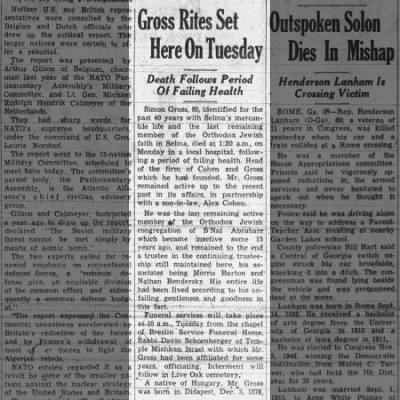
Around 1915, Simon founded his own merchant firm, S. Gross, on Broad Street in Selma — the same street where Isidore Kayser had given him his first American job ten years earlier. He stayed in business for the rest of his life. In 1947, when his son-in-law Alex Cohen joined the firm, it became Cohen and Gross. He was a 32nd-degree Mason and Shriner. He was the last remaining active member of B’Nai Abraham, Selma’s Orthodox congregation, which became inactive around 1942. In 1956–57 he helped the Selma Rotary Club resettle three Hungarian refugees, serving as their interpreter. The 1957 obituary in the Selma paper preserved a sentence in print: “He maintained always a deep affection for his native land, altho all members of his immediate family had long since left.”
Simon’s sister Amália Miriam Grósz Feldman, who had married Elias Feldman in Jákó, sent two of her sons after him. Sam Feldman, the second-oldest of her eight children, sailed alone from Fiume in 1907, age sixteen, and went to Mobile, Alabama — a hundred miles south of Selma. Henry “Hymie” Feldman, born in 1897, came in December 1921 on the R.M.S. Olympic and also went to Mobile to join Sam. Two years later Hymie left Alabama for Chicago to marry his first cousin Sarah Szerena Weisz — daughter of Simon’s other sister Rozalia. That was the pivot. From Hymie’s Chicago apartment all the rest of the story would unfold: Sarah Szerena in 1923, Esther in 1939, and finally, in 1950, Bobby Weisz — Simon’s great-niece, who had survived the camps and Sweden and arrived at Hymie’s apartment at 1247 S. California Avenue. None of that would have happened without Simon.
Simon died at 1:20 a.m. on Monday 11 November 1957 in a Selma hospital after a period of failing health. He was 78. His funeral was held on Tuesday morning at the Breslin Service Funeral Home, with Rabbi David Schoenberger officiating. He was buried at Live Oak Cemetery in Selma. The obituary in the Selma newspaper named his wife Mary Schwartz Gross (predeceased, 1951), his son Emile in Columbia, South Carolina, his three daughters Mrs. Alex Cohen of Selma, Mrs. Henry Raskin of Montgomery, and Mrs. Nathan Miller of Columbus, Georgia, and his five grandchildren including Miss Hermine Cohen.
He had lived in Selma for fifty-two years. He had crossed an ocean alone at twenty-six, sent for his wife and children in stages, founded a firm on Broad Street, become the gateway through which an entire family eventually came to America, and at seventy-four traveled north one more time to see the next generation married. The 1957 obituary in the Selma paper was right about almost everything except the year of his birth and the name of the village. The original record stands on a court form signed in his own hand in 1909.
Immigration documents are the highest authority. The 1957 obituary is used for narrative color and family relationships but is deprioritized for dates and names — obituary text was written from family memory five decades after the events.
U.S. District Court for the Southern District of Alabama at Selma. Form No. 2. The keystone document for Simon’s birth year (1878), birthplace (Nyíregyháza), physical description, occupation, and arrival particulars. When the 1957 obituary disagrees, this is the original record.
Same court. Form No. 14. Witnesses H.M. Eskridge (Salesman) and E.B. Kayser (Merchant) — evidence Simon had landed in an established Selma merchant network. Both forms together confirm his Selma address, occupation, marital status, and citizenship process.
Port of New York. Hamburg to NYC. Simon listed as single, age 26, headed for Selma, Alabama — even though he was already married with a son back in Nyíregyháza. The clerk recorded what Simon said.
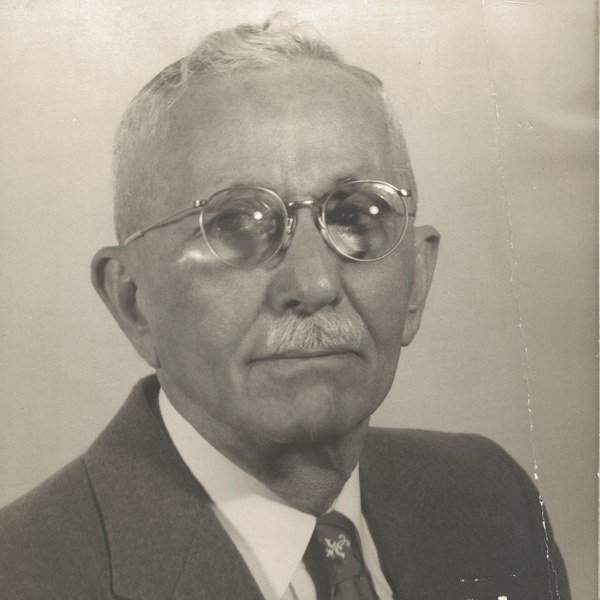
Simon at his Washington Street address. Mary and the older children had not yet crossed; Mammie, born in Selma in 1910, would be the first American-born child of the family.
Detailed and largely accurate on adult-life details (Broad Street firm, son-in-law, refugee work, Masonic life). Birth year and birthplace are wrong — the obit says “1876” and “Didapest,” both contradicted by the 1909 Declaration. The “Didapest” is a print rendering of Budapest, which is itself almost certainly the nearest big-city shorthand Simon used for American neighbors who would not recognize Nyíregyháza. Treated here as a narrative source and a record of how Simon’s American community remembered him.
Independently confirms burial at Live Oak Cemetery, Selma, Alabama. Used to cross-check the funeral and burial details given in the obituary.
The vetted prose treatment of Simon, Sam, Hymie, and the wider Selma-Mobile-Chicago network. Several details on this profile are anchored in that chapter’s research. Read Chapter Six →
The first member of this family to reach America · Roza Grósz's younger brother (Bobby's great-uncle) · arrived NYC on the SS Graf Waldersee from Hamburg, 22 May 1905, age 26 · settled in Selma, Alabama, working as a clerk · filed his Declaration of Intention 2 February 1909, formally renouncing allegiance to Francis Joseph, Apostolic King of Hungary · married Mary Schwarz · Hebrew name Elkanan ben Zvi · in 1952, age ~74, traveled from Alabama to Brooklyn for his great-niece Bobby's wedding to Laci — connecting the very first member of the family in America to the founding of the new family that would carry its memory · died 1957 · he is the real reason the next-generation nieces (Esther, Szerena) were drawn to America at all; Henry Feldman's 1920s arrival came later.