The founding document
Aunt Esther (Etelka) Weisz Schon — portrait from a 1984 family photograph in Chicago
— THE WRITER —

Esther's 1980 Letter

"My darling daughter Sandra — this is written by your mother, for you to know your roots, of which you can be very very proud, as I am."

Chicago · 15 December 1980 · 4 pages · handwritten
Download the original PDF 4 pages · handwritten · 725 KB Read the scans & transcription below ↓

— About this letter —

In December 1980, age 75, in Chicago, Esther Weisz Schon — born Esther-Etelka Weisz in Nyírbogát, Hungary, in 1905 — sat down to write her daughter Sandra a four-page letter naming the people of her family. Her grandparents Leib and Pessil. Her father Samuel and her mother Roza. Her aunts and uncles, her cousins, her siblings, the cousin-marriages that wove the Weisz and Feldman branches together, and the destruction of nearly all of them in 1944.

What Sandra had asked her, simply, was who are or were our cousins.

What Esther gave her in reply is the deepest layer of this archive. Most of the people Esther names in this letter exist on the record only because she wrote them down. She knew them personally. She was the family's senior memory by 1980. This letter is treated as factual throughout.

"My darling daughter Sandra, (Sore Rochel Gitl) — this is written by your mother, for you to know your roots, of witch you can be very very proud, as I am. I knew most of these people except my grandparents, they passed away when I was a child."

The transcription below preserves Esther's spelling, her parenthetical Hebrew/Yiddish name pairings, her crossed-out words, and her "continued on other side" line breaks. The four scanned pages appear alongside. The complete original PDF is available for download at the top of this page.

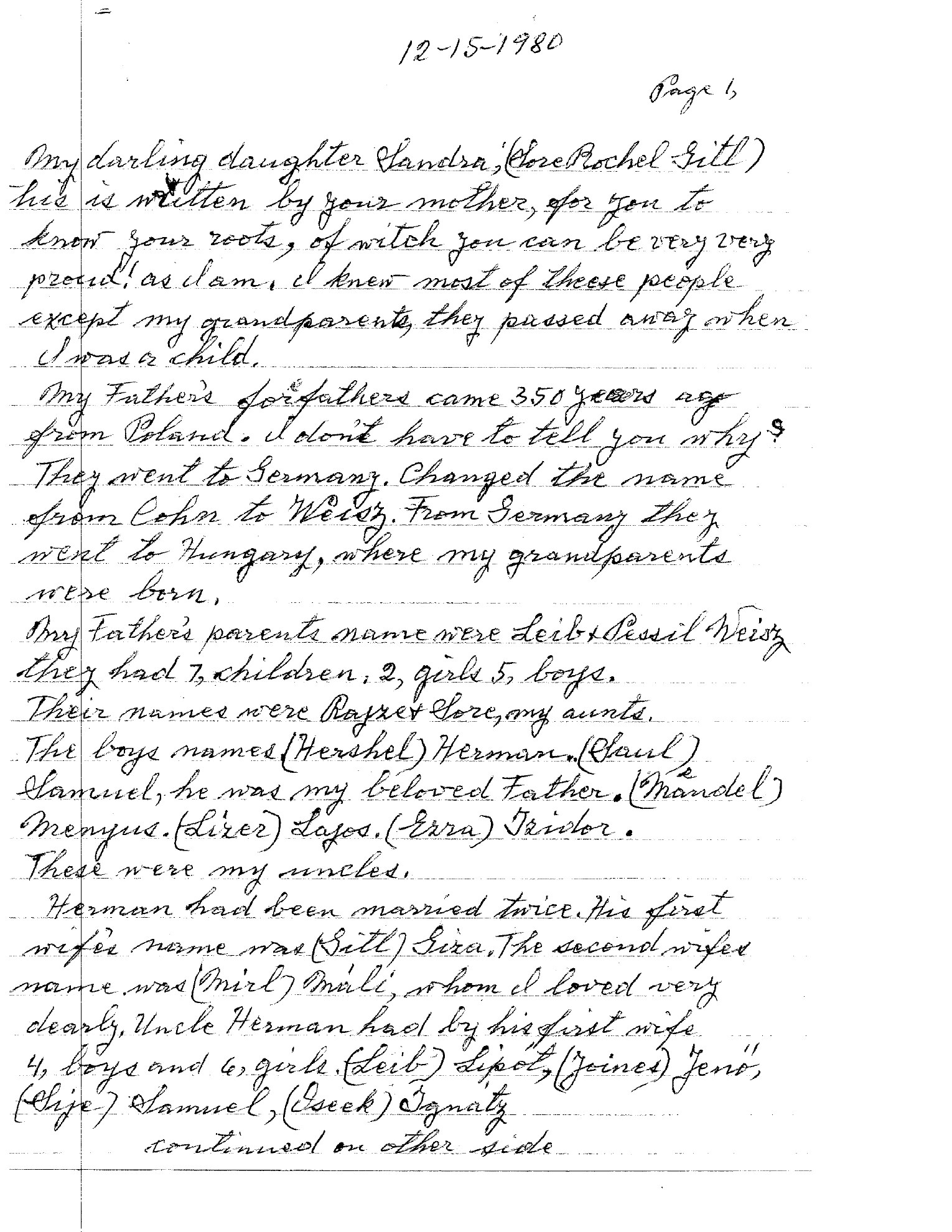
Page 1 of Esther's letter, December 15, 1980 — the opening salutation, the 350-years-from-Poland paragraph, and the beginning of the Weisz family genealogy.
Page 1 · the opening · the 350 years
Page One — 12-15-1980

My darling daughter Sandra, (Sore Rochel Gitl)

his is written by your mother, for you to know your roots, of witch you can be very very proud! as I am. I knew most of these people except my grandparents, they passed away when I was a child.

My Father's forfathers came 350 years ago from Poland. I don't have to tell you why? They went to Germany. Changed the name from Cohn to Weisz. From Germany they went to Hungary, where my grandparents were born.

My Father's parents name were Leib and Pessil Weisz — they had 7, children, 2, girls 5, boys. Their names were Rajze and Lore, my aunts.

The boys names: (Hershel) Herman. (Shaul) Samuel, he was my beloved Father. (Mandel) Menyus. (Lizer) Lajos. (Ezra) Izidor.

These were my uncles.

Herman had been married twice. His first wife's name was (Gitl) Giza. The second wife's name was (Mirl) Máli, whom I loved very dearly. Uncle Herman had by his first wife 4, boys and 6, girls. (Leib) Lipot, (Joines) Jenő, (Sije) Samuel, (Iseek) Ignatz

— continued on other side —
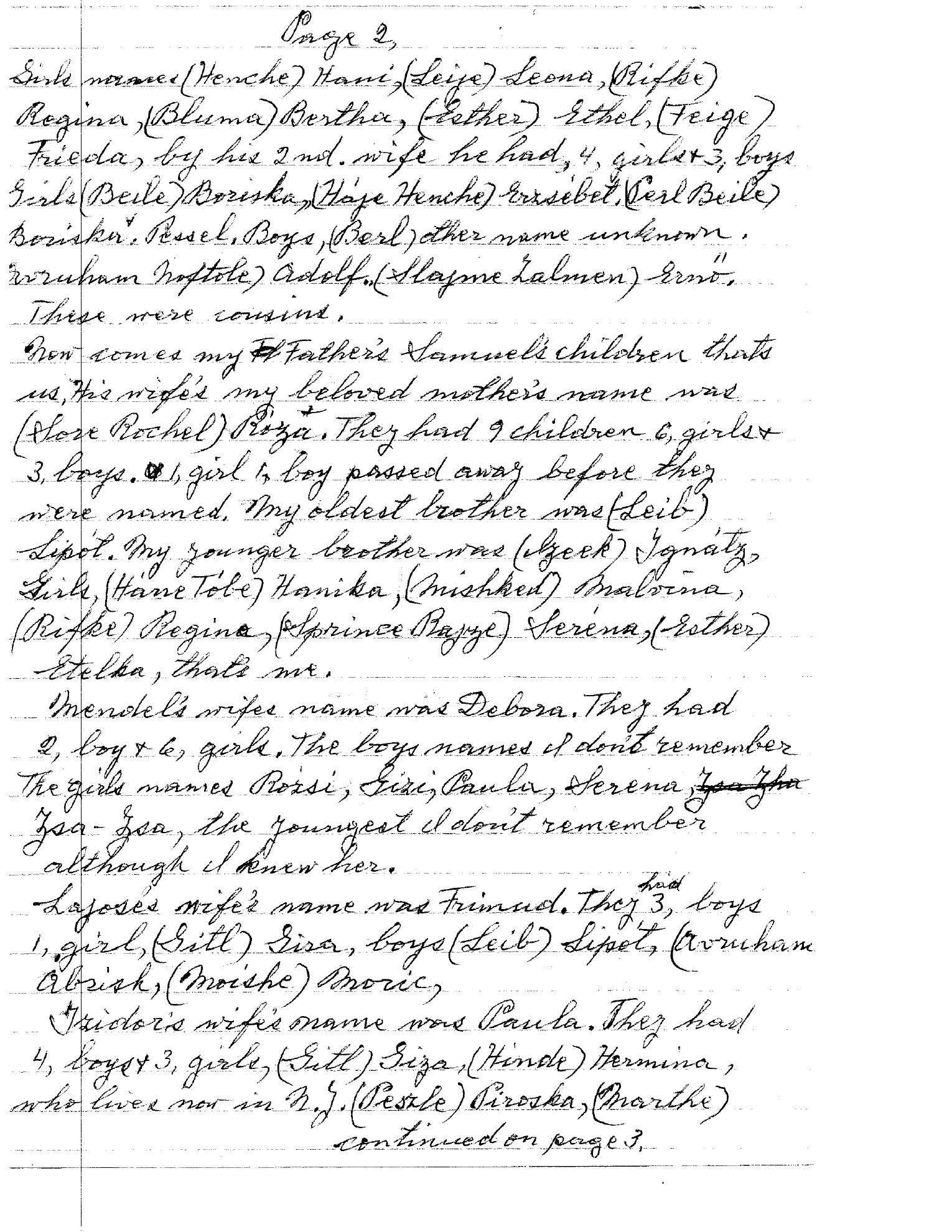
Page 2 of Esther's letter — Herman's daughters, his second wife's children, then Samuel's nine children with Roza, and the families of Mendel, Lajos, and Izidor.
Page 2 · Herman's family · Samuel + Roza's nine
Page Two

Girls names: (Henche) Hani, (Leiye) Leona, (Rifke) Regina, (Bluma) Bertha, (Esther) Ethel, (Feige) Frieda. By his 2nd. wife he had 4, girls and 3, boys. Girls: (Beile) Boriska, (Háje Henche) Erzsébet, (Perl Beile) Boriska, Pessel. Boys: (Berl) — other name unknown. (Avruham Naftole) Adolf. (Slayme Zalmen) Ernő.

These were cousins.

Now comes my Father's Samuel's children that's us. His wife's — my beloved mother's name was (Sore Rochel) Róza. They had 9 children, 6, girls and 3, boys. 1, girl 1, boy passed away before they were named. My oldest brother was (Leib) Lipot. My younger brother was (Iseek) Ignatz. Girls: (Hane Tobe) Hanika, (Mishked) Malvina, (Rifke) Regina, (Sprince Rayze) Serena, (Esther) Etelka, that's me.

Mendel's wife's name was Debora. They had 2, boy and 6, girls. The boys names I don't remember. The girls names: Rózsi, Gizi, Paula, Serena, Zsa Zha Zsa-Zsa. The youngest I don't remember although I knew her.

Lajos's wife's name was Trimud.[1] They had 3, boys and 1, girl: (Gitl) Giza — boys (Leib) Lipot, (Avruham Absish), (Moishe) Moric.

Izidor's wife's name was Paula. They had 4, boys and 3, girls: (Gitl) Giza, (Hinde) Hermina — who lives now in N.J. (Pessle) Piroska, (Marthe)

— continued on page 3 —
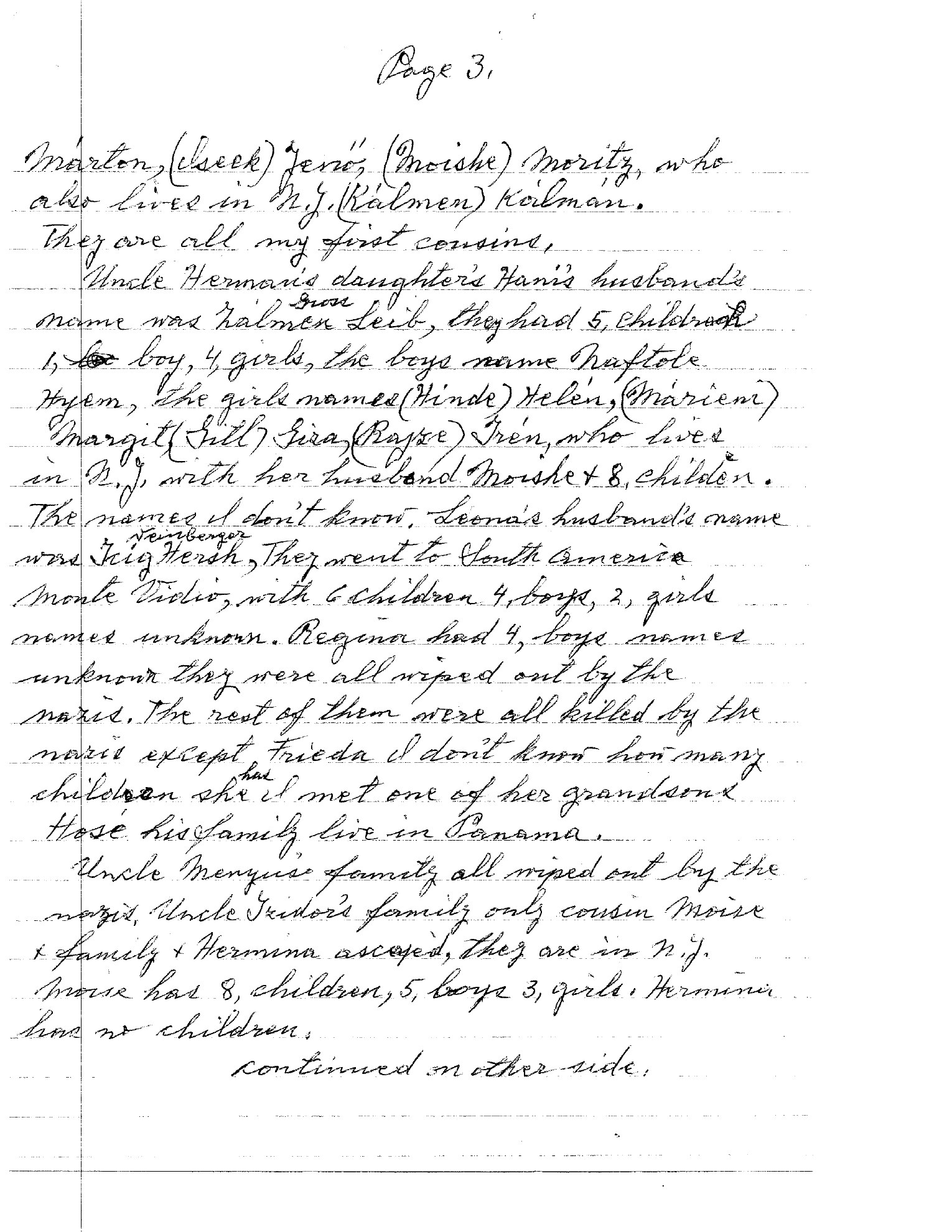
Page 3 of Esther's letter — completing the cousins list, Hani's marriage to Kalmen Leib, Leona's family in Montevideo, and the murder pattern of the nazis through Herman's children, Menyus's family, and Izidor's family.
Page 3 · the cousins · the murders · the escapes
Page Three

Márton, (Iseek) Jenő, (Moishe) Moritz — who also lives in N.J. (Kálmen) Kálmán.

They are all my first cousins.

Uncle Herman's daughter Hani's husband's name was Kalmen Leib.[2] They had 5, children, 1, too boy 4, girls. The boys name Naftole Hyem. The girls names (Hinde) Helen, (Marien) Margit, (Gitl) Giza, (Rayze) Iren — who lives in N.J. with her husband Moishe and 8, children. The names I don't know.

Leona's husband's name was Itzig Hersh (Veinberger).[3] They went to South America, Monte Video, with 6 children, 4, boys 2, girls. Names unknown.

Regina had 4, boys, names unknown. They were all wiped out by the nazis.

The rest of them were all killed by the nazis except Frieda — I don't know how many children she had. I met one of her grandsons, Hose — his family live in Panama.

Uncle Menyus's family — all wiped out by the nazis.

Uncle Izidor's family — only cousin Moise and family, and Hermina, escaped. They are in N.J. Moise has 8, children, 5, boys 3, girls. Hermina has no children.

— continued on other side —
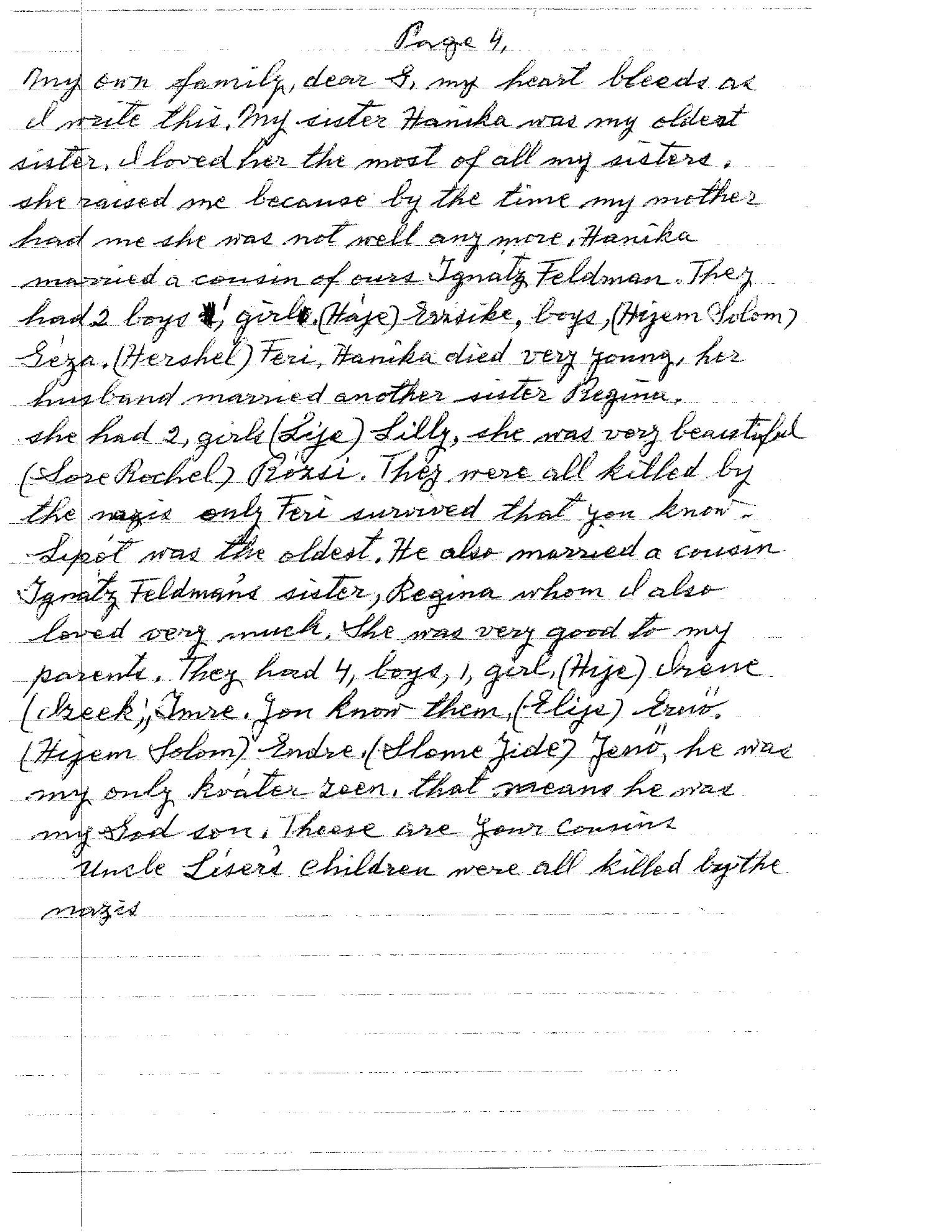
Page 4 of Esther's letter — the cousin marriages: Hanika to Ignatz Feldman, Regina to him after, Lipot to Ignatz Feldman's sister Regina. The murder of nearly all of them in 1944 except Feri, Imre, and Irene (Bobby).
Page 4 · my own family · my heart bleeds
Page Four

My own family, dear S — my heart bleeds as I write this.

My sister Hanika was my oldest sister. I loved her the most of all my sisters. She raised me, because by the time my mother had me she was not well any more. Hanika married a cousin of ours, Ignatz Feldman. They had 2 boys and 1, girl. (Háje) Erzsike. Boys (Hyem Solom) Géza, (Hershel) Feri. Hanika died very young. Her husband married another sister, Regina. She had 2, girls — (Lije) Lilly, she was very beautiful, (Sore Rochel) Rózsi. They were all killed by the nazis, only Feri survived, that you know.

Lipot was the oldest. He also married a cousin — Ignatz Feldman's sister, Regina, whom I also loved very much. She was very good to my parents. They had 4, boys and 1, girl: (Hije) Irene, (Iseek) Imre — you know them — (Eliys) Ernő, (Hyem Solom) Endre, (Shlome Jide) Jenő — he was my only krater zeen.[4] That means he was my god son.

These are your cousins.

Uncle Liser's children were all killed by the nazis.

The letter ends here, mid-page, with no closing salutation visible. The final words above are the last words Esther wrote.

— On the ambiguous readings —

  1. Reading confirmed as Trimud after re-examination of the handwritten original on 10 May 2026. The leading letter is a T, matching Esther's T-forms elsewhere on the page. Earlier Frimud / Trinud renderings have been retired.
  2. Reading confirmed as Kalmen Leib after re-examination of the handwritten original on 10 May 2026. The first letter is a K, matching Esther's K-forms elsewhere on the page (e.g. Kálmán, krater). No surname is given in the letter; earlier renderings as Zalmen Leib Gross with a surname have been retired.
  3. Veinberger appears written above the line as a clarification or surname. This is the Weinberger family in Montevideo.
  4. Krater zeen — Yiddish, kvater-zun: god-son / sandek's child. Esther was the kvater (the woman who hands the infant to the sandek) at this nephew's bris.

— Provenance —

Original 4-page handwritten letter held by Sandra Schon Kiferbaum, Esther's daughter.

Scanned and transmitted to Eli Feig in 2025 for inclusion in the family archive.

View original PDF (all 4 pages) View verified transcription (Markdown)