The Camps
Where the family was taken · what the camps were · who was there · what happened
The direct family members taken in the Hungarian deportations of May–July 1944 were: Emanuel and Lina Klein, Ilona Klein, Regina Feldman Weisz, Leopold "Lipot" Weisz, Ignácz Feldman, Miriam Grósz Feldman, and Lajos Weisz (Samuel's older brother, taken from Nyírmeggyes at age 78) — along with Jenő Klein, Irene Weisz, and Imre Weisz, who survived. This is where they were sent. Each camp is documented with its specific purpose, the dates it operated, the labor or function imposed on the prisoners, and the outcome for our family members known to have passed through it.
The six Szabolcs-Szatmár villages (gold dots) converged at the Nyíregyháza ghetto in April 1944. From there, the entire family was put on cattle cars through Kassa (where Hungarian gendarmes handed custody to SS guards) to Auschwitz-Birkenau in late May. Three survivors were sent onward: Jenő to Buchenwald and then the Tröglitz/Rehmsdorf subcamp on the Brabag fuel plant (the family Zeitz lager), evacuated to Theresienstadt April 1945; Lipot to Mauthausen and then Ebensee; and Bobby to Bergen-Belsen, then via the Red Cross White Buses to Sweden.
EXTERMINATION & CONCENTRATION CAMP Auschwitz-Birkenau Oświęcim, occupied southern Poland · largest of the Nazi camp complex
Auschwitz-Birkenau
On arrival, prisoners were subjected to a selection on the ramp — SS doctors decided in seconds who would be sent directly to the gas chambers (the elderly, mothers with small children, the visibly sick) and who would be kept alive temporarily for forced labor. Those selected to die were told they would be showering, led into underground chambers, and killed with Zyklon B gas, with bodies then cremated in adjacent crematoria. Those selected for labor were shaved, tattooed with a prisoner number on the forearm, dressed in striped uniforms, and housed in barracks meant for a fraction of the numbers held. Rations were calorie-insufficient by design; the average camp lifespan for a working prisoner was weeks to a few months. The camp operated continuously at industrial scale until Soviet troops arrived in January 1945.
Hungary was the last major Jewish community of Europe still largely intact in spring 1944. Following Germany's occupation of Hungary on 19 March 1944, Adolf Eichmann personally oversaw the deportation of Hungarian Jewry to Auschwitz. Between 15 May and 9 July 1944, roughly 437,000 Hungarian Jews were deported in 147 sealed trains. Most arrived at Birkenau. Upon arrival the majority — including nearly all children, elderly, and mothers — were gassed within hours. The killing was so compressed in time and scale that a new rail spur was built directly into Birkenau to speed unloading. This operation is how almost every Hungarian Jew our family lost reached Auschwitz.
FORCED-LABOR SUBCAMP KZ Ebensee Ebensee, Austria · Austrian Alps · subcamp of Mauthausen
KZ Ebensee
Prisoners dug tunnels into the limestone mountains surrounding Ebensee by hand, in shifts of twelve hours or more, often without adequate food, clothing, or shelter. The work day began at 4:30 a.m. Prisoners carried rocks up steep stairs cut into the hillside — the "Löwengang" (Lions' Walk) — between the camp and the quarry. The SS used the code names Kalk (limestone), Zement (cement), and Solvay to disguise the true purpose. The first winter of 1943–44 was particularly lethal — barracks were unfinished, bodies accumulated in huts, and corpses were transported every few days back to Mauthausen for cremation until Ebensee built its own crematorium in summer 1944. By the final months of the war, the barracks built to hold 100 prisoners each held 750; many slept in the tunnels themselves or outdoors. Jews made up about a third of the camp population; approximately 3,200 of the Jewish victims buried in the Ebensee cemetery were Hungarian. This is where Lipot was in the final months of his life.
Since 1948 the Ebensee concentration camp cemetery has been an international memorial site. The 8,412 known victims are recorded on 156 panels of clear glass, arranged alphabetically by year of death and erected in 1997. In 2014 an additional panel was added for victims identified since then. Lipot's name — Weiss Leopold — appears on one of the panels for the year 1945.
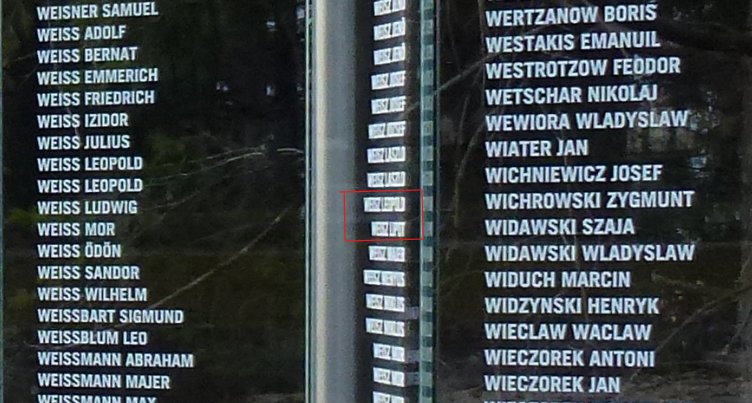
The alphabetical section of a single Ebensee memorial glass panel · "WEISS LEOPOLD" appears twice; one is Lipot
The full list of 8,412 names is available as a PDF from the memorial site —
Lipot's line is on page 297.
GHETTO-CONCENTRATION CAMP · TRANSIT CAMP Theresienstadt (Terezín) Terezín, Czechoslovakia · 30 miles north of Prague · former Austro-Hungarian garrison town
Tröglitz / Rehmsdorf (“Wille” · Brabag)
The subcamp was created on 4 June 1944 when the first 200 Jewish prisoners arrived from Buchenwald. By September 1944 the camp held more than 5,000 men, most of them Hungarian Jews deported via Auschwitz. There was no housing for them yet, so the Brabag management had a temporary tent camp erected for 5,000; by December 1944 the prisoners had themselves built a camp of 18 stone barracks in Rehmsdorf, three kilometers from the plant, and moved into it — with no sanitary facilities and a 3 km walk to the factory every day. Working conditions were catastrophic: twelve-hour days of heavy construction and clearing work, insufficient food, constant SS harassment. After roughly four weeks most prisoners could no longer meet the demands. The SS continuously replaced them, sending the “unfit” back to Buchenwald and many of those onward to Auschwitz to be murdered; a single transport on 8 February 1945 returned about 800 men this way. The future Nobel laureate in literature Imre Kertész was at the same subcamp and later wrote about it in Fatelessness (1975). On the night of 6–7 April 1945 the camp was hastily evacuated: the SS loaded the remaining ~3,000 prisoners onto a train of ten open coal wagons headed for Theresienstadt via Leitmeritz. About 900 died en route. The train ended at Reitzenhain, ninety kilometers short of Theresienstadt, after an American Air Force attack. There, SS men and local residents shot at least 380 prisoners who tried to escape. The survivors were force-marched the rest of the way to Theresienstadt. Of the approximately 8,600 prisoners who passed through Tröglitz and Rehmsdorf between June 1944 and April 1945, more than 5,800 died.
Jenő's wartime path is documented in the Yad Vashem Central Database of Shoah Victims’ Names, record #4744989. The path Auschwitz → Buchenwald → Tröglitz/Rehmsdorf (Brabag) → Theresienstadt is consistent with the wider documented record of Hungarian-Jewish men deported in May 1944 and routed to the Brabag subcamp from June 1944 onward.
Theresienstadt (Terezín)
Theresienstadt was not designed as an extermination center — which is why it had one of the highest survival rates of any Nazi camp. Its prisoners died from disease, starvation, and exposure in overcrowded conditions (the town, normally home to 7,000, held over 50,000 at peak). The camp operated under a Jewish Council of Elders who managed daily life, and maintained a remarkable cultural life — concerts, lectures, theater, children's opera — under conditions of mass death. The Nazis exploited this cultural life in June 1944 by staging a Red Cross visit to pretend the camp was a humane resettlement community. After the Red Cross left, deportations to Auschwitz resumed. In the final weeks of the war, trains from evacuating camps flooded Theresienstadt, bringing typhoid. The camp was the last major Nazi camp liberated.
CONCENTRATION CAMP · LIBERATION CAMP Bergen-Belsen Lower Saxony, Germany · near Celle · originally a POW camp, converted to concentration camp in 1943
Bergen-Belsen
Bergen-Belsen was not an extermination camp by design. It had no gas chambers. Its prisoners died from starvation, exposure, and disease — especially typhus, which swept through the overcrowded barracks in early 1945. By the final weeks, the camp was a holding ground for thousands of women and men too weak to stand, arriving daily from evacuation marches out of camps in Poland and Germany. Irene arrived at Bergen-Belsen from her women's labor camp (likely a Gross-Rosen or Flossenbürg subcamp) in this evacuation wave, in the winter or early spring of 1945. She was among the roughly 60,000 prisoners still alive on 15 April 1945, when the British 11th Armoured Division reached the camp gates.
On liberation day, British forces immediately began emergency medical care — but survivors continued to die at a rate of ~500 per day for weeks. Two weeks earlier, Swedish diplomat Count Folke Bernadotte had negotiated with Heinrich Himmler to evacuate Scandinavian and other prisoners to Sweden. After the British liberation, the operation expanded to all nationalities. The Swedish Red Cross "White Buses" brought approximately 10,000 mostly Hungarian-Jewish young women out of Bergen-Belsen to Sweden from mid-April through July 1945 — starting the very day of liberation. Irene was among them. Sweden did not register religion — only names, dates, and origin camp — so her intake card is preserved at the Riksarkivet (Swedish National Archives) in Stockholm, locatable by her birth date and village.
PARENT CAMP SYSTEM Mauthausen (context) Mauthausen, Austria · near Linz · the main camp of the complex that included Ebensee
Mauthausen (context)
Included here for context: Lipot's Ebensee record exists because Ebensee was a Mauthausen subcamp — prisoner registration, death records, and transfer documentation all flowed through Mauthausen administration. The Mauthausen Memorial today holds the primary archive for both camps.
Eight members of this family were taken to these camps. Five did not come home — Emanuel, Lina, Ilona, Regina, Ignácz, and Lipot. Three did — Irene, Imre, and Jenő. Everything that came after, in Brooklyn, exists because of the three who survived.